
Product Design




Jul 20, 2026
Bumble Zip/ Zoodle
ZipString’s simple, satisfying play mechanic has strong potential, but the current experience is limited to a single toy and interaction. The challenge was to explore how ZipString could evolve into a broader play ecosystem that encourages repeat engagement and future purchases through new gameplay, characters, and expandable experiences.
Duration
4 weeks
Date
Category
Product Design
Overview
ZipString is a sponsored product development project exploring the next generation of play for the ZipString toy. The project focused on expanding its simple string-launching mechanic into more engaging, repeatable experiences that could grow into a larger product line.
Opportunity
ZipString’s core mechanism is intuitive and satisfying, creating an opportunity to build new forms of play around it. By introducing physical interaction, competition, character development, and collectible elements, the toy could become more than a one-time purchase.
Concept Development
Started with 30+ concepts exploring different ways to extend the ZipString mechanism and create new play experiences. After evaluating the concepts, we narrowed the direction to 8 concepts, developing rough physical models to test interaction, scale, and gameplay.
Final Concepts
The exploration ultimately resulted in two refined concepts: BumbleZip and Zoodle, each approaching the opportunity from a different gameplay strategy.
BumbleZip
BumbleZip transforms ZipString into an active, full-body balancing game. A forehead-mounted launcher continuously sends the string horizontally when activated, with a lightweight flower balloon included.
Players become the bees, moving and balancing their bodies to keep their flower floating. Designed for both solo and multiplayer play, BumbleZip turns the simple ZipString mechanism into a playful physical challenge centered around movement, coordination, and balance.
Zoodle
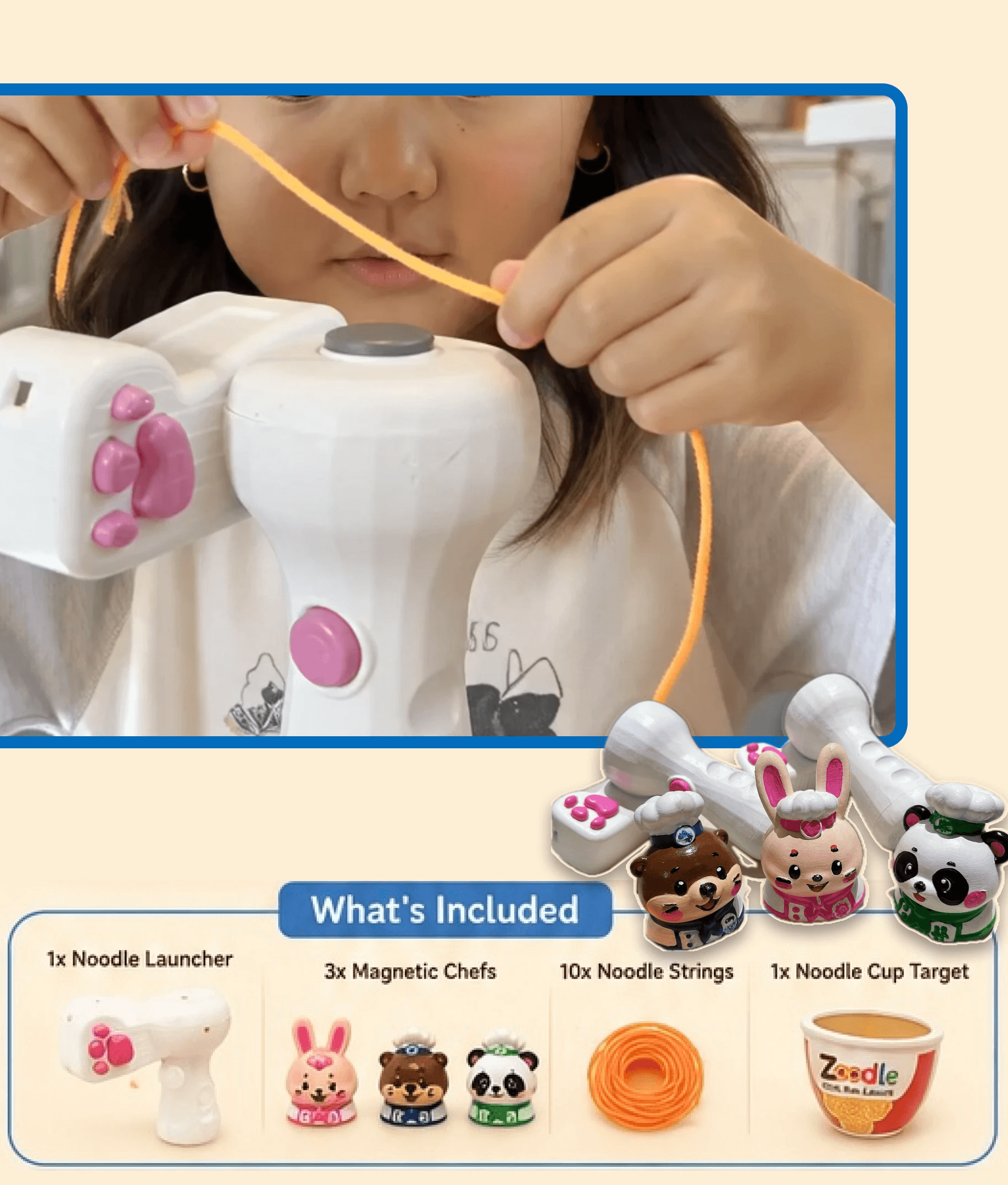
Zoodle reimagines ZipString as a competitive noodle-launching game. Players choose between three chef characters—Panda, Bunny, and Otter—each with their own colored “noodle” string and launcher.
Players compete to aim their noodles into target cups, which can be placed on surfaces, attached to walls, or hung at different heights to increase the challenge. The character system introduces collectibility and personality, while the modular targets create opportunities for evolving gameplay.
Form & Prototyping
Both concepts were developed through rough physical modeling and iterative prototyping, allowing us to evaluate the physicality of each interaction before developing the final look-like prototypes.
Outcome
Two distinct directions for expanding the ZipString ecosystem—one centered around active physical play and character-driven interaction, and the other around competitive gameplay and collectibility. Both retain the satisfying core mechanic of ZipString while creating new reasons to play, collect, and return.
Related Articles

Mono
View

kafA
View