
User Experience








Aug 10, 2025
Néo
The experience of waking at night is universally disruptive — disorienting, isolating, and poorly served by existing lighting solutions that prioritize function over feeling. Conventional nightlights interrupt the environment rather than integrate with it.
Duration
5 weeks
Date
Category
User Experience
Group: Jenny Gao, Xin Yi Lim, Gladys
Overview
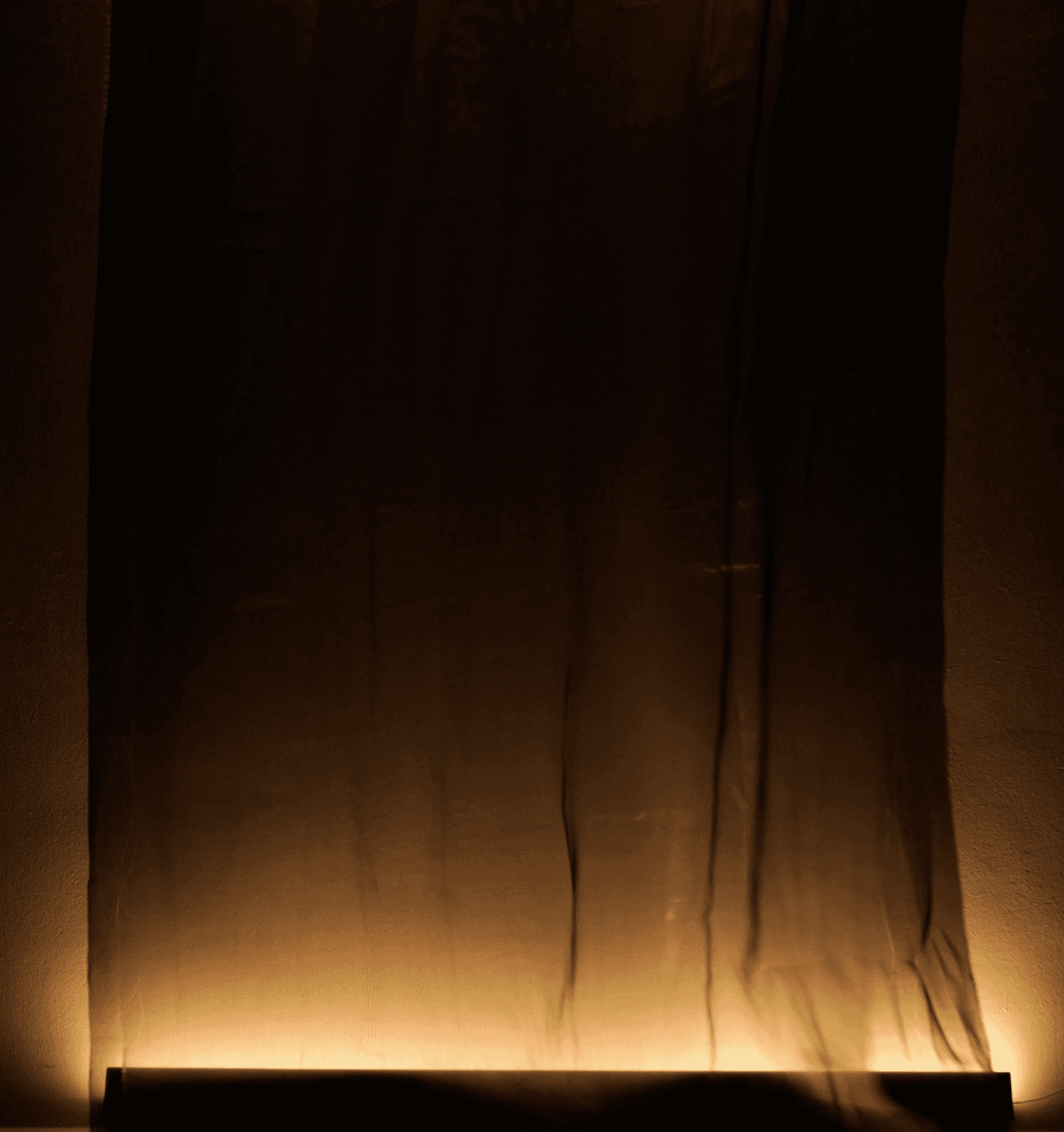
Néo is a full-wall textile installation designed to redefine the nocturnal domestic experience. It functions as ambient infrastructure — present without imposing, guiding without alerting.
Opportunity
Singapore's HDB typology presents a unique design condition: open-plan layouts, cross-ventilating airflow, and porous thresholds between interior and exterior. This environmental openness became the generative premise for the project.
Concept
Rather than designing a product, we designed a journey — from the discomfort of sudden wakefulness to a state of calm reassurance. néo borrows the logic of a comfort object: something familiar, soft, and quietly present. The slogan where night meets day captures its core duality.
Interaction Design
The installation is a continuous touch surface. As users move through their space at night, the fabric responds passively to their presence and motion. Touch interaction is incidental, intuitive, and non-transactional — no switches, no UI, no friction.
Experience
At night, natural airflow animates the layered organza, producing gentle wave-like movement that plays with fibrance lighting — a dreamlike visual continuity that eases the transition back to rest. By day, the black organza layer slowly retracts, leaving iridescent fabric to catch and scatter natural light throughout the HDB.
Form & Material
Two organza layers — black and iridescent — were selected through iterative testing for their combined capacity to produce depth, diffusion, and a tactile softness. Fibrance lighting embedded within creates an even, glowless luminance. The wave motion is driven entirely by ambient airflow, requiring no mechanical input.
Systems Thinking
Néo operates within the existing environmental systems of the HDB: ventilation as motion driver, daylight as activator, spatial layout as interaction map. The piece adapts its behavior based on time of day and atmospheric conditions — passive sensing without sensors.
Outcome
A living, responsive installation that reframes the nightlight as spatial experience rather than utility object — dissolving the boundary between artwork, architecture, and care.
Related Articles

3D Navigator
View

MangoMango
View